

Le Corbusier
La Chaux-de-Fonds
1887 -
Roquebrune-Cap-Martin
1965
In 1900 Charles-Edouard Jeanneret-Gris began to study at the École d'Art in La Chaux-de-Fonds, Switzerland. He trained as an engraver and goldsmith but, from 1904, also studied architecture. He made history as one of the leading 20th-century architects. The foundations of Le Corbusier's aesthetic were laid on his extensive travels and the work he did at leading architecture practices, including work for the distinguished German architect Peter Behrens in Berlin in 1910-11.
Le Corbusier concentrated on building with steel and reinforced concrete. In 1917 he moved to Paris and assumed the nom d'artiste Le Corbusier. In 'L"Esprit Nouveau", the journal he founded in 1919, Le Corbusier formulated his ideas of modern architecture. His painting, emphasising clear forms and structures, corresponds to his architecture, which is based on elemental geometric forms.
In 1943 Le Corbusier applied a similar interdisciplinary approach to developing "Modulor", a system of proportion based on the male figure and the Golden Mean, used to determine the proportions of units in architecture and technology. It is also the basis of Le Corbusier's work in furniture design. Many of his pieces of furniture have become design classics.
In addition to individual buildings - such as the "Weißenhof Settllement" in Stuttgart (1927) and Villa Savoye in Poissy (1929-31) - Le Corbusier was interested in mass-produced urban housing and town planning. He disseminated his ideas in a host of theoretical writings on architecture as well as the Congrès Internationaux d'Architecture Moderne and the Athens Charter, published in 1944, in which Le Corbusier laid out guidelines for urban planning.
One of Le Corbusier's most important postwar housing complexes is Unité d'Habitation in Marseilles and his pilgrimage chapel, Notre-Dame-du-Haut, in Ronchamps is perhaps his most radical work.
One of the most important and influential architects of the 20th century, Le Corbusier died on 27 August 1965.
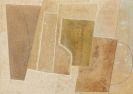
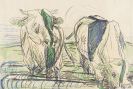

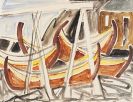



Would you like to sell a work by Le Corbusier?
Infos for seller


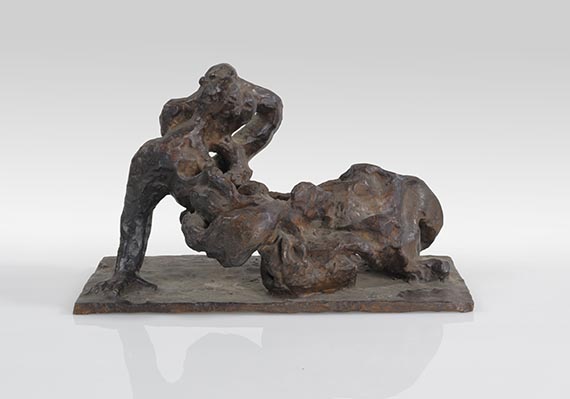
Starting bid: 4,500 EUR